
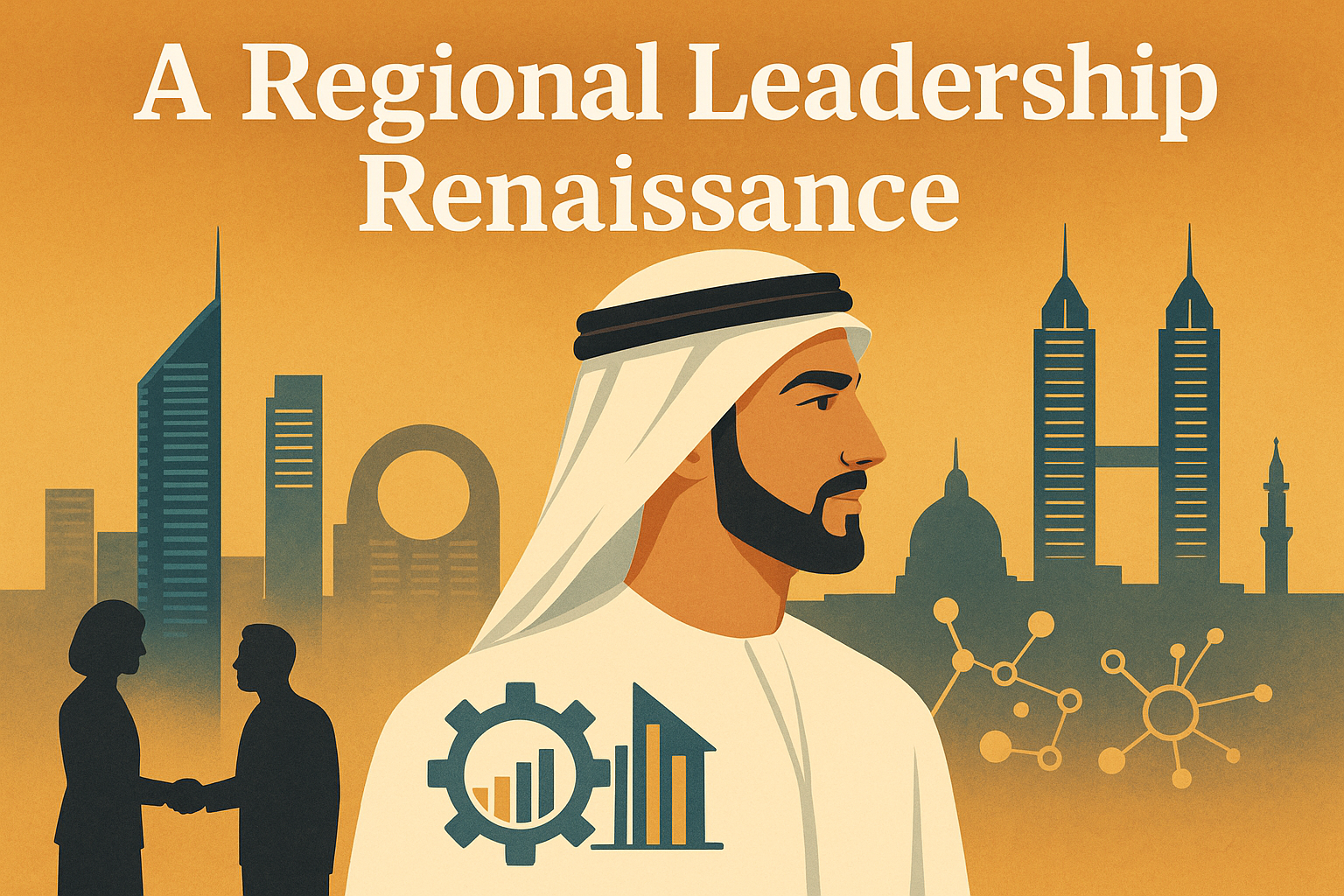
A Regional Leadership Renaissance
The Arab region is experiencing a defining inflection point not only economically, but in the very architecture of its leadership. Across the Gulf, Levant, and North Africa, a new breed of Arab visionaries is emerging: leaders who are not merely managing institutions but reinventing them. The region’s leadership model, once anchored in hierarchy, state-driven enterprise, and traditional business orthodoxy, is evolving toward agility, inclusivity, and innovation.
In this new era, Arab leaders are reimagining their role in a digital and multipolar world. They are the bridge between legacy and disruption blending the wisdom of tradition with the velocity of modern transformation. From the boardrooms of Riyadh and Dubai to the entrepreneurial hubs of Cairo and Casablanca, the Arab world is cultivating a leadership culture that is both global in perspective and deeply rooted in local identity.
The Structural Shift: From Oil Dependency to Knowledge Economies
For decades, the Arab world’s economic powerhouses were defined by oil wealth and state-centered industrial policies. However, the narrative is shifting dramatically. The Gulf Cooperation Council (GCC) states particularly Saudi Arabia, the UAE, and Qatar are spearheading a regional pivot toward diversified, knowledge-based economies driven by technology, innovation, and entrepreneurship.
Saudi Arabia’s Vision 2030 has catalyzed this transformation by investing in megaprojects like NEOM and the Red Sea Global, positioning the Kingdom as a hub for sustainability, tourism, and digital manufacturing. The UAE, meanwhile, has doubled down on its Economic Agenda 2031, seeking to triple its non-oil exports and foster a trillion-dollar economy powered by AI, fintech, and advanced industries.
In North Africa, countries like Egypt and Morocco are pursuing reforms to modernize industries, attract foreign investment, and enhance competitiveness through digital transformation. Morocco’s renewable energy initiatives including its vast solar installations in Ouarzazate demonstrate how leadership in sustainability is becoming a defining feature of national strategy.
In the Levant, Jordan and Lebanon, despite economic pressures, are cultivating innovation ecosystems in education, healthtech, and creative industries, showing that even smaller economies can redefine their global standing through human capital and technological integration.
This wave of transformation is reshaping leadership expectations: Arab executives are no longer evaluated solely by quarterly returns or expansion metrics but by their ability to create ecosystems that are innovative, inclusive, and globally resilient.
The Leadership Mindset Shift: From Command to Collaboration
Historically, leadership across much of the Arab world mirrored hierarchical governance authority-driven, linear, and centralized. Today, the tide is turning. The modern Arab leader operates within networks, not pyramids. Decision-making is becoming distributed, organizations are becoming flatter, and leadership is increasingly measured by empowerment, not control.
Executives across the region now prioritize agility, open innovation, and cross-sector partnerships. For instance, Bahrain’s Economic Development Board works hand-in-hand with startups and venture capital firms to foster fintech ecosystems, while Oman’s Vision 2040 is built around multi-stakeholder collaboration to diversify its industrial and logistics sectors.
Arab leaders are also embracing design thinking and adaptive leadership frameworks encouraging experimentation over conformity. In many ways, this reflects a broader socio-economic maturity: a recognition that resilience in the modern economy is built through inclusion, trust, and collective intelligence.
Human Capital as the Engine of Future Leadership
If oil was the capital of the 20th century Arab economy, human talent is the currency of the 21st. The Arab region holds one of the youngest populations globally with over 55% of citizens under the age of 30. This demographic advantage, if nurtured, can drive one of the most significant human-capital transformations in modern history.
Saudi Arabia’s Human Capability Development Program and the UAE’s Nafis initiative are examples of forward-looking leadership aimed at equipping citizens for the digital economy. These programs are embedding lifelong learning, technical upskilling, and entrepreneurship at the core of national development.
At the enterprise level, leading firms are transforming corporate cultures. Emirati conglomerates like ADNOC and Mubadala are redefining energy leadership by embedding AI and sustainability into operational DNA. Egyptian banks are training their staff in data analytics and customer experience design. And across the Levant, small and medium-sized enterprises are leveraging remote collaboration tools to compete globally.
Leadership is thus becoming human-centered driven by empathy, diversity, and purpose. In boardrooms across the region, emotional intelligence and inclusivity are no longer “soft” skills; they are strategic imperatives.
Digital Transformation and Data-Driven Leadership
Technology is no longer a support function it is the strategic frontier of leadership. The Arab world’s emerging leaders are digitally fluent, using technology not only for operational efficiency but for strategic foresight and innovation.
Governments have recognized this shift, launching national AI strategies, smart cities, and data ecosystems. The UAE’s appointment of the world’s first Minister of State for Artificial Intelligence in 2017 signaled a regional turning point, institutionalizing AI as a governance priority. Saudi Arabia’s Data and AI Authority (SDAIA) has followed suit, driving national digitalization efforts that align with global ESG standards.
Leaders across the Arab private sector are also harnessing digital platforms to reimagine customer experience, supply-chain agility, and workforce productivity. The rise of LinkedIn collaborations, cloud migration initiatives, and digital learning academies demonstrates that technology is becoming both a strategic tool and a cultural language.
This new wave of digital leadership transcends mere adoption of tools it is about cultivating a data-driven mindset across every level of the organization. Leaders who combine digital literacy with ethical foresight are becoming the true architects of regional competitiveness.
Sustainability, ESG, and Purpose-Driven Leadership
Perhaps the most defining hallmark of the region’s new leadership is the integration of sustainability into strategy. From environmental stewardship to social inclusion, ESG (Environmental, Social, and Governance) principles are no longer peripheral they are central to corporate and governmental missions.
The Middle East’s leadership in renewable energy is setting global benchmarks. Saudi Arabia’s Green Initiative, the UAE’s Net Zero 2050 Strategy, and Egypt’s Green Hydrogen Corridor are not just climate pledges they represent a leadership mindset that prioritizes long-term value creation over short-term gains.
Arab CEOs and policymakers are increasingly positioning sustainability as both an ethical and economic imperative. Boards are mandating ESG reporting, impact investing, and circular-economy models. The result is a leadership ecosystem that fuses purpose with performance redefining what corporate success means in the Arab context.
Cultural Intelligence: Balancing Identity and Innovation
Cultural intelligence the ability to navigate local tradition while embracing global modernity is emerging as one of the most valuable traits of Arab leaders. Unlike in many Western economies, leadership in the Arab world is deeply tied to heritage, community, and collective values.
Modern leaders are learning to reconcile these timeless principles with the demands of innovation-driven economies. They are nurturing corporate cultures that honor respect and trust while promoting experimentation and meritocracy. This duality honoring the past while engineering the future is what gives Arab leadership its distinct character.
From family-owned enterprises evolving into global conglomerates, to public institutions adopting agile frameworks, this synthesis of culture and innovation is shaping a unique Arab model of progress.
Geopolitical Dynamics and Regional Integration
The Arab region sits at the intersection of continents and global supply chains a position that grants both opportunity and responsibility. The new generation of leaders recognizes that geopolitical awareness is as critical as business acumen.
Recent normalization agreements, intra-GCC coordination, and the rise of pan-Arab infrastructure and logistics projects have created new pathways for regional synergy. The Arab Economic Unity Council is exploring digital trade frameworks, while the Abraham Accords have opened new technological and investment corridors.
Forward-looking leaders are leveraging these dynamics to build economic resilience through cross-border collaboration. The expansion of sovereign wealth funds into Africa and Asia demonstrates that Arab capital is not just reactive but strategically global shaping industries from renewable energy to AI research across continents.
The Future of Arab Leadership: A Vision Beyond Borders
The Arab world’s next-generation leaders are global in ambition but regional in spirit. They see leadership as an act of nation-building, ecosystem creation, and social transformation. Their legacy will not be measured in GDP or market share, but in how effectively they reshape education, digital governance, sustainability, and innovation for the next century.
As digital borders dissolve and regional cooperation deepens, Arab leadership will increasingly influence the global agenda. From smart governance to climate diplomacy and ethical AI, the Arab region’s emerging leaders are poised to contribute meaningfully to the global future not as followers, but as architects.
A Leadership Epoch in Motion
The Arab world stands at a historical convergence where economic diversification, technological acceleration, and cultural renewal intersect. This is not merely an era of reform; it is an era of redefinition.
The new Arab leader is adaptive, data-driven, inclusive, and visionary. They understand that leadership in this century is about more than guiding organizations — it is about shaping societies, industries, and the collective destiny of the region. In essence, Arab leadership is no longer about managing change it is about creating it.
Related Blogs : https://arabworldleaders.com/category/articles/