

Customer experience (CX) has become one of the most important competitive advantages for modern businesses. Organisations invest heavily in digital tools, transformation initiatives, employee training, and customer engagement strategies, believing these efforts will naturally translate into better customer satisfaction. Yet, despite significant investment, many transformation programs fail to produce the expected results.
The reason is rarely a lack of ambition or commitment. More often, businesses lose sight of what customers are actually experiencing.
Leadership teams typically begin transformation with a clear vision. Strategic objectives are established, budgets are approved, technology is implemented, and employees are encouraged to embrace change. Progress is monitored through dashboards, reports, and performance indicators, creating the impression that customer experience is steadily improving. However, the reality experienced by customers may tell a different story.
As information travels through different organisational layers, the authentic customer perspective can become filtered, simplified, or unintentionally altered. What reaches senior leadership is often a polished version of reality rather than an accurate reflection of everyday customer interactions.
This disconnect is supported by industry research. According to Medallia’s 2026 State of Customer Experience Report, while two-thirds of CX professionals believe customer experience improved during the previous year, fewer than one in five customers share that opinion. This gap highlights an important challenge: organisations often measure success internally while customers evaluate success through every interaction they have with the brand.
The people who possess the clearest understanding of customer expectations are usually those working closest to them.
Customer service representatives, branch employees, retail staff, technicians, and support teams encounter customer frustrations long before they appear in executive reports. They witness recurring issues, inefficient processes, communication gaps, and the small obstacles that gradually erode customer trust. Every day, they gather valuable insights that rarely receive the same attention as operational metrics or financial reports.
Research by Gallup reinforces this reality. Many employees genuinely care about delivering excellent customer experiences and feel personally responsible for customer satisfaction. Yet significantly fewer believe their organisations consistently deliver on the promises made to customers. This suggests that employee commitment is rarely the problem. Instead, organisations often lack effective systems for transforming frontline observations into meaningful organisational improvements.
Middle management plays an equally important role in this equation.
Managers operate between executive strategy and frontline execution. They are responsible for balancing operational performance, financial targets, employee engagement, compliance requirements, and transformation initiatives simultaneously. Under constant pressure to deliver measurable outcomes, their attention naturally shifts toward objectives that are regularly monitored and rewarded.
When organisations intentionally encourage managers to elevate frontline feedback and incorporate customer insights into decision-making, transformation becomes more practical and sustainable. Employees become more engaged because they see their observations influencing change, while customers benefit from improvements that directly address their concerns.
Technology has become another major focus of customer experience transformation. Artificial intelligence, automation, predictive analytics, and digital platforms are reshaping how organisations interact with customers. These innovations offer tremendous opportunities to personalise experiences, improve efficiency, and generate deeper insights.
Nevertheless, technology alone cannot resolve organisational disconnects.
Many CX leaders acknowledge that integrating new technologies into existing organisational structures remains one of the greatest implementation challenges. Successful customer experience depends less on the sophistication of digital tools and more on whether every part of the organisation shares a consistent understanding of customer needs.
Ultimately, exceptional customer experience is created through organisational alignment rather than technology alone.
Leaders must remain connected to the reality customers experience rather than relying exclusively on reports and performance dashboards. Spending time alongside frontline teams, listening directly to customer conversations, and encouraging open communication creates a far more accurate understanding of business performance.
Equally important is establishing a culture where customer feedback moves upward without being diluted, while strategic priorities flow downward with clarity and purpose. When every organisational level shares responsibility for customer outcomes, transformation becomes more than a strategic initiative it becomes part of everyday decision-making.
The organisations most likely to succeed in the future will not necessarily be those with the largest transformation budgets or the newest technologies. Instead, they will be those that consistently preserve the authentic customer perspective throughout every layer of the business.
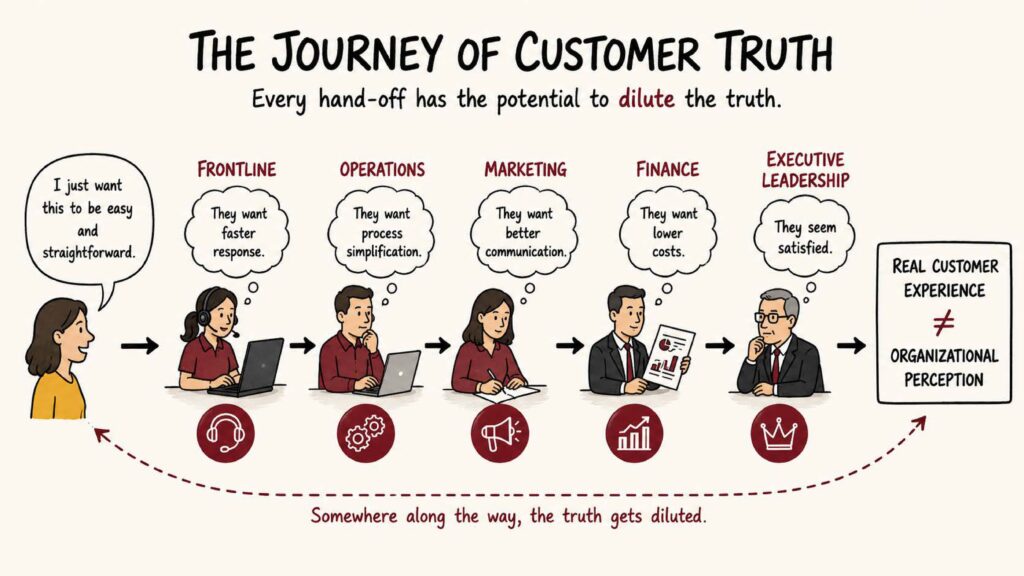
Three important principles emerge from this perspective:
- Employees closest to customers often identify problems before anyone else. Organisations succeed when leadership actively listens to those voices.
- Customer experience is influenced by countless daily decisions made across every department, not only by executive strategy or frontline service.
- Sustainable transformation happens when organisations ensure customer insight remains visible, trusted, and actionable from the first customer interaction to the highest levels of leadership.
By strengthening the connection between leadership, managers, and frontline employees, businesses create an environment where customer truth drives better decisions, stronger relationships, and long-term business success.
Related Blogs: https://arabworldleaders.com/category/business-news/