
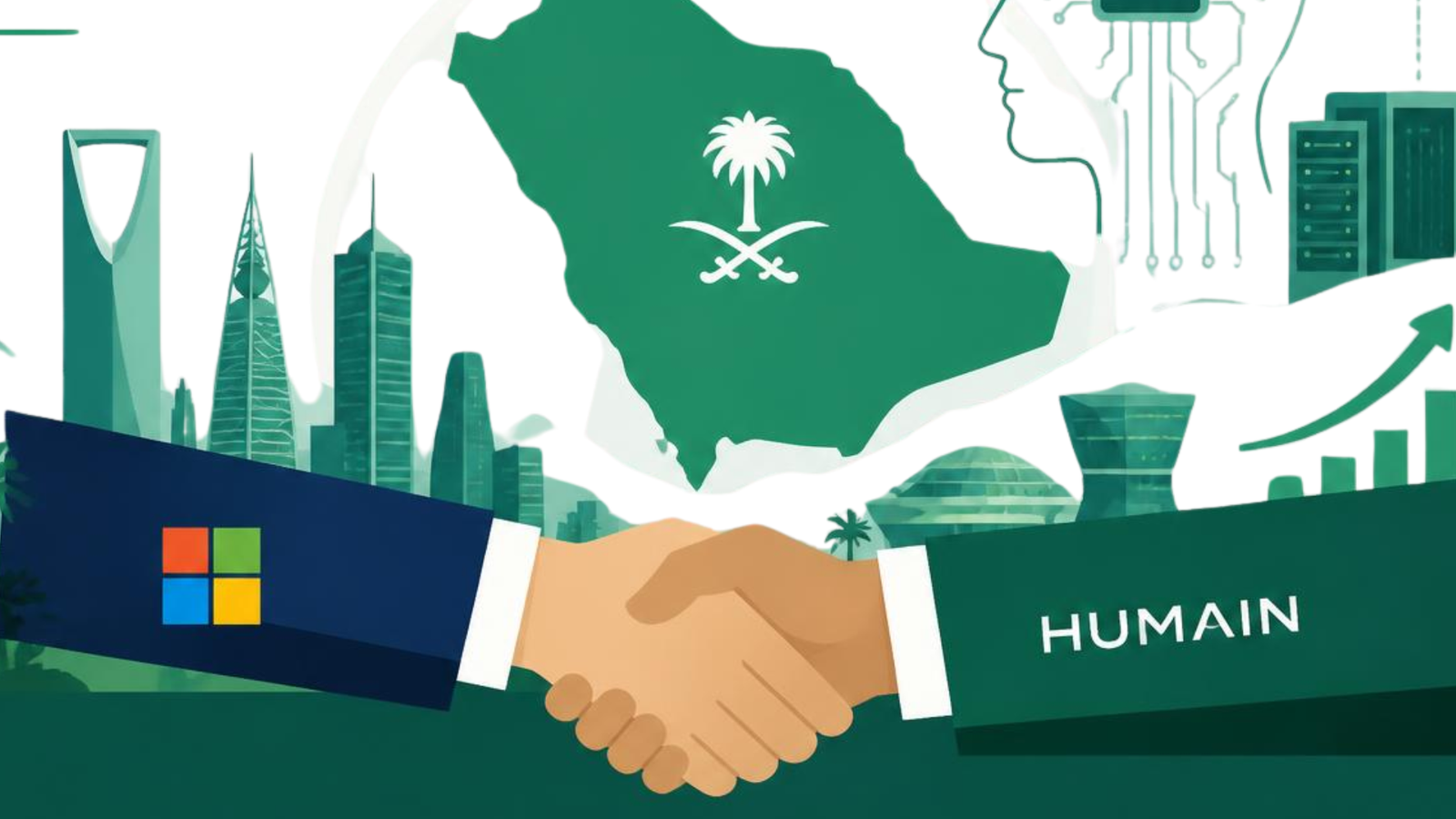
Saudi Arabia’s artificial intelligence ambitions are entering a new and more commercially significant phase. The Kingdom is moving beyond the early stage of announcing ambitious digital-transformation targets and is increasingly building the infrastructure, technology partnerships, AI models and enterprise capabilities required to operate artificial intelligence at scale. The latest long-term collaboration between Microsoft and Saudi Arabia’s HUMAIN is an important development in that transition because it connects Saudi Arabia’s locally developed AI capabilities with one of the world’s largest enterprise technology ecosystems.
The partnership is centred on accelerating AI adoption in Saudi Arabia and beyond, with particular attention to Arabic-language artificial intelligence. HUMAIN’s ALLAM models are expected to become available through Microsoft’s AI development ecosystem, including Microsoft Foundry and the Microsoft 365 Copilot environment. The companies are also combining engineering capabilities to help organisations identify practical AI applications, develop solutions and move them into production. This is significant because the next stage of the global AI market is increasingly shifting away from simply developing larger models and toward integrating AI into everyday business operations.
For Saudi Arabia, the timing is particularly important. The Kingdom has been investing heavily in digital infrastructure, cloud computing, data centres and advanced technologies as part of its broader economic diversification agenda. Artificial intelligence fits naturally into that strategy because it can influence productivity across energy, finance, healthcare, manufacturing, logistics, government, education and retail. Instead of creating a technology sector that exists separately from the rest of the economy, Saudi Arabia is attempting to make AI a foundational technology that can support transformation across multiple industries.
The Microsoft-HUMAIN collaboration therefore represents more than a conventional technology partnership. It connects three increasingly important elements of Saudi Arabia’s technology strategy: local AI development, global enterprise technology and large-scale infrastructure. HUMAIN contributes regional AI capabilities and Arabic-language expertise, while Microsoft contributes cloud, enterprise software, AI-development platforms and a large international business ecosystem. The combination could help Saudi organisations move from AI experimentation toward wider commercial deployment.
The infrastructure side of this transformation is equally important. Saudi technology company Al Moammar Information Systems, commonly known as MIS, has been involved in major HUMAIN infrastructure projects, including a previously announced contract worth approximately SAR 1.88 billion for the design and construction of an AI-focused data centre. That project demonstrates how the AI opportunity is expanding beyond software into construction, computing, networking, power management, cooling systems and specialised data-centre services.
A separate HUMAIN agreement disclosed by MIS in August 2026 involves data-centre colocation services over a five-year period, further indicating that Saudi Arabia’s AI infrastructure requirements are developing into a recurring business market rather than being limited to individual construction projects. This distinction is important because the AI economy requires not only facilities to be built but also long-term capacity to be operated, maintained, secured and expanded.
Together, the developments point toward an emerging Saudi AI ecosystem in which international technology companies, domestic technology providers, infrastructure operators, investors and AI specialists increasingly participate in the same value chain. The objective is becoming clearer: Saudi Arabia wants to develop the capacity to build, host, deploy and commercialise AI, rather than simply consume AI products developed elsewhere.
From AI Ambition to AI Infrastructure
The biggest change occurring in Saudi Arabia’s AI market is the recognition that artificial intelligence cannot grow at scale without enormous physical infrastructure. Generative AI applications require computing power, specialised processors, high-speed networks, data storage, electricity and sophisticated cooling systems. As businesses increasingly adopt AI agents and organisations process larger quantities of data, demand for this infrastructure is expected to increase substantially.
A simple AI experiment can operate on relatively limited computing resources, but national-scale or enterprise-scale deployment is very different. A government platform serving millions of citizens, a bank deploying AI across thousands of employees or a multinational company operating AI applications across multiple markets needs highly reliable infrastructure. Systems must be available continuously, data must be protected, and computing capacity must be capable of handling unpredictable increases in demand.
This is why the approximately SAR 1.88 billion HUMAIN-MIS infrastructure project is strategically important. It illustrates the scale of investment required to establish dedicated AI computing environments in Saudi Arabia. The project is not merely about constructing another conventional data centre. AI-oriented facilities require infrastructure designed around increasingly demanding workloads, including high-performance computing, networking and specialised cooling.
The implications extend throughout the domestic economy. When Saudi Arabia invests in AI infrastructure, it creates opportunities for construction companies, engineering firms, telecommunications providers, cybersecurity specialists, technology integrators, cloud-service companies and equipment suppliers. The development of AI therefore has the potential to generate economic activity across multiple industries simultaneously.
The data-centre economy also creates a long-term operational market. Once a facility is built, it needs technicians, engineers, security specialists, network administrators, cooling systems, electricity management and continuous maintenance. This creates recurring employment and commercial opportunities rather than a one-time construction effect. The newer colocation-services agreement between MIS and HUMAIN reinforces this trend. A five-year infrastructure relationship suggests that AI capacity is increasingly being treated as a long-term service requirement. For companies participating in the sector, recurring contracts can provide greater visibility into future revenue while allowing infrastructure providers to justify further investment in capacity.
This is particularly important because AI infrastructure is highly capital intensive. Data centres require substantial upfront investment, but their commercial success depends on sustained utilisation over many years. Long-term agreements can therefore become an important part of the economic model supporting the regional AI build-out. Saudi Arabia is effectively creating the physical foundation for a new digital economy. The country’s AI strategy is consequently becoming intertwined with data-centre development, cloud computing, telecommunications, energy infrastructure and advanced engineering.
HUMAIN’s Role in Saudi Arabia’s AI Strategy
HUMAIN occupies a central position in Saudi Arabia’s emerging AI ecosystem. Backed by the Public Investment Fund, the company has been positioned around a full-stack approach to artificial intelligence, covering infrastructure, computing, AI models and applications.
That structure is strategically important because Saudi Arabia is attempting to avoid dependence on a single layer of the AI industry. Building a model without sufficient computing infrastructure can create bottlenecks. Building data centres without strong applications can leave capacity underutilised. Developing infrastructure and models without enterprise customers can make it difficult to generate commercial returns. HUMAIN’s role is therefore to connect these different layers.
Its ALLAM models provide a regional AI capability, particularly for Arabic-language applications, while its infrastructure ambitions provide the computing environment required to operate those models. Partnerships with global technology companies then provide pathways for businesses to access and use these capabilities.
Microsoft adds an especially important international dimension. The company has a vast enterprise customer base and established technologies used by governments, corporations and institutions around the world. Connecting HUMAIN’s AI capabilities to Microsoft’s ecosystem could potentially make regional AI technology more accessible to organisations already operating within Microsoft environments.
The partnership also demonstrates how Saudi Arabia is approaching technological sovereignty differently from a strategy based entirely on isolation. Rather than attempting to develop every element of the AI stack independently, the Kingdom is seeking international partnerships while simultaneously developing domestic capabilities.
This hybrid approach could become one of Saudi Arabia’s strongest advantages. International companies bring expertise, technology and global distribution, while Saudi organisations provide regional knowledge, investment and access to the local market. The result could be a technology ecosystem that is both internationally connected and regionally specialised.
Why Arabic AI Could Become a Strategic Technology Market
Arabic-language artificial intelligence could become one of the most strategically important areas of the Middle East’s technology economy. For much of the generative-AI boom, the strongest commercial attention has been directed toward English-language models and applications. Arabic has increasingly been supported by major global AI systems, but the requirements of Arabic-speaking users extend beyond simple translation.
Arabic is a complex language with numerous dialects, different vocabulary patterns and distinct cultural contexts. Businesses operating across the Middle East and North Africa often need systems that understand formal Arabic, regional language variations and industry-specific terminology. Government institutions, banks, healthcare providers and large enterprises also deal with substantial volumes of Arabic documentation. This creates an opportunity for specialised regional models.
HUMAIN’s ALLAM models are positioned around Arabic-language AI capabilities, and the Microsoft partnership could help bring those capabilities into enterprise development and productivity environments. If organisations can build applications using Arabic AI within tools they already use, the barrier to adoption could become significantly lower.
The opportunity could extend across the entire MENA region. Saudi Arabia represents the largest commercial market within the Gulf, but Arabic-language AI has potential applications in the UAE, Qatar, Kuwait, Bahrain, Oman, Jordan, Lebanon, Egypt and North African markets. Each country has different regulatory and economic conditions, but businesses share many requirements around Arabic communication, customer service, documentation and digital transformation.
The regional AI opportunity could therefore become much larger than Saudi Arabia alone. For financial institutions, Arabic AI could improve customer engagement and internal knowledge management. For government agencies, it could assist with document analysis and citizen-facing services. For retailers, it could enable more natural Arabic customer interactions. For media organisations, it could support content workflows. For education providers, it could help create Arabic-language learning materials and research tools. The strategic value lies in developing AI systems that understand the language and context of the market, rather than simply translating an English-centric AI experience.
The Enterprise AI Opportunity
The biggest commercial opportunity may ultimately come from enterprise adoption. The AI industry has already demonstrated that organisations are interested in generative AI. The harder challenge is converting that interest into measurable improvements in productivity and profitability.
Companies need to determine which tasks should be automated, which processes should remain human-led and how AI can safely interact with sensitive corporate information. They also need to connect AI systems with existing enterprise software, databases and workflows. Microsoft’s ecosystem is particularly relevant in this environment because many organisations already use its productivity and cloud technologies. Bringing regional AI capabilities into that environment could make it easier for businesses to experiment with Arabic AI without rebuilding their technology infrastructure from scratch.
The potential applications are extensive. A financial institution could use AI to analyse internal documents and assist employees with research. A logistics company could use AI to improve planning and customer communications. An energy company could use intelligent systems to analyse operational information. A government agency could deploy AI for internal knowledge management and citizen-service workflows.
The economic value comes when these systems reduce administrative work, improve decision-making or allow employees to spend more time on higher-value activities. That is why the partnership’s focus on practical implementation is important. The next competitive advantage may not belong to the organisation with access to the most powerful AI model, but to the organisation that can integrate AI most effectively into its operations.
AI Agents and the Next Enterprise Shift
Artificial intelligence is now moving from simple question-and-answer systems toward AI agents capable of performing sequences of tasks. This could significantly change how businesses use technology.
A traditional software application waits for a user to give it instructions. An AI agent can potentially interpret a goal, gather information, interact with software tools and complete several steps with limited human intervention. For example, an employee might ask an AI system to prepare a market report. Instead of simply generating text, an agent could potentially retrieve approved company information, analyse data, prepare a draft, organise the information and deliver it through an existing workplace platform. However, deploying such systems safely is much more complicated than launching a chatbot.
Companies need governance frameworks, permission controls, security measures, reliable data and human oversight. They must also determine what an AI agent is allowed to access and which decisions require human approval. This is where Microsoft’s enterprise AI capabilities and HUMAIN’s regional expertise could complement one another. The partnership aims to support organisations as they identify valuable use cases and move AI applications into real operational environments. The ability to implement AI responsibly could become one of the defining technology-management challenges for Saudi companies over the next several years.
The Data-Centre Economy Behind the AI Boom
The physical infrastructure supporting AI is becoming an economic sector in its own right. AI data centres are significantly different from traditional facilities because high-performance computing systems can generate enormous amounts of heat and require advanced cooling. They also require substantial electricity and high-speed connectivity.
This means Saudi Arabia’s AI ambitions are connected to the country’s energy and infrastructure strengths. The Kingdom has extensive experience managing large-scale energy projects and developing major infrastructure, giving it a potential advantage as demand for AI computing increases. However, the infrastructure challenge is not simply about building more facilities.
Saudi Arabia must ensure that data centres can operate efficiently, securely and sustainably. Power availability, cooling technology, water management, cybersecurity and network connectivity will all influence the economics of future facilities. The AI infrastructure market will consequently create opportunities for companies developing more efficient cooling systems, power-management technologies, high-speed networks and specialised data-centre equipment. The development of AI could therefore accelerate innovation in several infrastructure sectors simultaneously.
Saudi Arabia’s AI Strategy Is Becoming an Economic Strategy
The deeper significance of the Microsoft-HUMAIN and MIS developments is that artificial intelligence is becoming increasingly integrated into Saudi Arabia’s broader economic transformation agenda. Saudi Arabia has been pursuing economic diversification for years, with technology and advanced industries forming important components of that strategy. AI adds another dimension because it can improve productivity across almost every sector rather than operating as an isolated industry.
The energy sector can use AI to optimise assets and identify maintenance requirements. Financial institutions can use it to analyse risk and improve customer experiences. Manufacturing companies can use intelligent systems to improve production and quality management. Healthcare organisations can apply AI to administrative and analytical processes. Retailers can use it for demand forecasting and customer engagement.
This cross-sector impact gives AI unusual economic significance. If successfully deployed, AI could help companies achieve more with existing resources while creating entirely new categories of products and services. That could make AI one of the technologies contributing to the next stage of Saudi Arabia’s productivity growth. The challenge, however, will be ensuring that investment translates into measurable economic outcomes. Building data centres and developing AI models creates technological capacity, but the economic benefits ultimately depend on how effectively companies and institutions use that capacity.
From Local AI to Regional AI
Saudi Arabia’s long-term opportunity may extend well beyond its domestic market. If HUMAIN succeeds in developing competitive Arabic AI capabilities and connecting them with international enterprise technology, Saudi Arabia could potentially become a regional centre for Arabic AI development. This would create opportunities for startups as well as large corporations.
Entrepreneurs could develop specialised applications on top of regional AI infrastructure. Financial technology companies could create Arabic-first services. Healthcare startups could build specialised language applications. Education companies could develop Arabic learning platforms. Cybersecurity companies could create tools designed for regional organisations.
A strong AI infrastructure ecosystem could consequently reduce barriers for startups because entrepreneurs would not need to build every layer of technology themselves. This could produce a multiplier effect in Saudi Arabia’s startup ecosystem. Large infrastructure investment creates the platform. Global technology partnerships provide tools and expertise. Local entrepreneurs build applications. Businesses become customers. Investors finance successful companies. That is how an AI ecosystem can begin to develop beyond a small group of major corporations.
A New Competition for AI Infrastructure
The global AI race is increasingly becoming a race for computing capacity, energy, talent and investment. The United States continues to benefit from the world’s largest technology companies and established cloud platforms. China has developed a large domestic technology ecosystem, while Europe is strengthening its own AI capabilities and regulatory environment.
The Gulf is pursuing a different model. Saudi Arabia and other Gulf economies have access to significant investment capital, major infrastructure programmes and substantial energy resources. They are using those advantages to attract technology partnerships and build domestic AI capabilities.
Saudi Arabia’s strategy through HUMAIN is therefore part of a wider effort to establish the Kingdom as an important centre of the global AI economy. The objective is not simply to attract foreign technology companies. It is to capture more of the AI value chain, from infrastructure and computing to models, applications, investment and enterprise adoption. If successful, this could change Saudi Arabia’s position within the global technology industry. Rather than being primarily a major consumer market for international technology companies, the Kingdom could become a location where technology is developed, financed, deployed and exported.
What the MIS Contract Reveals About the Private Sector
The HUMAIN-MIS relationship also reveals how the AI transformation could reshape Saudi Arabia’s domestic private sector. Large technology projects create demand for a wide network of companies. Data-centre construction requires engineering and project-management expertise. Operating the infrastructure requires technology specialists, network engineers, cybersecurity teams and maintenance providers.
At the same time, businesses need consultants and system integrators to connect AI platforms with existing corporate systems. This means companies do not necessarily need to develop their own AI models to benefit from the AI economy. A construction company can participate in data-centre development. A telecom company can provide connectivity. A cybersecurity firm can secure AI systems. A software company can build applications. A consulting company can help enterprises implement AI.
The approximately SAR 1.88 billion infrastructure project demonstrates the scale at which this ecosystem can develop. The newer five-year colocation-services agreement adds an additional layer by demonstrating the potential for recurring business relationships around AI infrastructure. This could encourage Saudi technology companies to expand their capabilities and invest in specialised talent.
The Investment Case Is Becoming Broader
The investment opportunity surrounding Saudi Arabia’s AI economy is no longer limited to companies developing AI models. It increasingly encompasses the entire technology infrastructure chain.
Computing is fundamental because AI workloads require specialised processing capacity. Data centres provide the physical environment for that computing. Cloud platforms make computing resources accessible to organisations. AI models provide the underlying intelligence. Enterprise applications turn that intelligence into practical business tools. AI agents can then automate increasingly complex workflows.
Investment is therefore spreading across multiple layers of the ecosystem. For investors, this creates both opportunities and challenges. Infrastructure companies can benefit from long-term demand, but they also require significant capital expenditure. AI application companies can grow quickly, but they must demonstrate genuine commercial value. Model developers can gain strategic importance, but they face intense global competition.
Saudi Arabia’s advantage may come from combining these layers rather than relying on a single category. The Microsoft-HUMAIN relationship connects global technology infrastructure with regional AI capabilities, while HUMAIN’s infrastructure partnerships provide the physical foundation needed to support increasing demand.
What Comes Next?
The next question is no longer whether Saudi Arabia intends to invest heavily in artificial intelligence. That direction is increasingly clear. The more important question is whether the Kingdom can convert its investment into a sustainable, productive and commercially successful AI economy. This will depend on talent, infrastructure, regulation, cybersecurity, enterprise adoption and the ability of companies to demonstrate real returns from AI.
Saudi Arabia will need highly skilled engineers and researchers capable of developing and managing advanced systems. It will need organisations willing to redesign business processes around AI. It will need strong governance frameworks to ensure that AI is deployed responsibly. It will also need to maintain the infrastructure required to support increasingly demanding workloads.
Perhaps most importantly, AI projects will need to move beyond impressive demonstrations and produce measurable business outcomes. A powerful AI model does not automatically create productivity. A large data centre does not automatically create economic growth. The real value emerges when organisations use these capabilities to solve problems, reduce costs, improve services and create new businesses. This is why the Microsoft-HUMAIN partnership is particularly important. It places greater emphasis on the transition from AI capability to AI implementation.
Saudi Arabia’s Emerging AI Formula
The developments point toward an emerging formula for Saudi Arabia’s technology economy: Saudi capital, sovereign AI infrastructure, Arabic-language models, global technology partnerships and enterprise adoption working together as one ecosystem.
If this model succeeds, Saudi Arabia could develop a distinctive position in the global AI market. The Kingdom does not necessarily need to compete with Silicon Valley across every category of artificial intelligence. Instead, it can concentrate on areas where it has structural advantages, including access to investment capital, large-scale infrastructure development, energy resources, government-led digital transformation and a substantial Arabic-speaking market.
Microsoft contributes global enterprise technology and AI expertise. HUMAIN contributes Saudi-backed AI capabilities and regional focus. MIS and other infrastructure companies contribute the physical systems required to operate AI at scale. Investors provide the capital required for expansion. Startups can then build new applications on top of the emerging infrastructure.
This creates a potentially powerful cycle in which infrastructure supports applications, applications generate demand, demand attracts investment and investment supports further infrastructure development. That makes the Microsoft-HUMAIN partnership and HUMAIN-MIS infrastructure projects more significant than isolated corporate announcements. They are indicators of a broader transformation in which artificial intelligence is becoming part of Saudi Arabia’s industrial infrastructure and economic strategy.
For businesses across the Gulf, Levant and North Africa, the implications could be substantial. The next generation of regional technology companies may not simply import AI products from the United States, Europe or Asia. They may increasingly build solutions around regional AI models, Arabic-language capabilities and locally hosted computing infrastructure. Saudi Arabia is attempting to establish itself at the centre of that transition.
The Microsoft-HUMAIN collaboration provides an international technology bridge, while the expanding HUMAIN infrastructure programme provides the computing foundation. Together, they point toward a future in which Saudi Arabia seeks to participate across the full AI value chain from capital and infrastructure to models, applications and enterprise adoption. The most important test will now be execution.
If Saudi Arabia can successfully turn its investments into widely adopted AI products, productive enterprises and a thriving startup ecosystem, the Kingdom’s AI programme could become one of the most important technology-driven economic transformation stories in the MENA region.
And if Arabic-language AI develops into a globally competitive capability, Saudi Arabia could eventually influence not only how the Gulf uses artificial intelligence, but how the wider Arabic-speaking world interacts with the technology. The next chapter of Saudi Arabia’s AI story will therefore be measured not by the size of individual announcements, but by the businesses, industries and new markets that emerge from the infrastructure and partnerships now being built.
Related Blogs: https://arabworldleaders.com/category/business-news/